爱情公寓4
Manus to return as independent company as separation from Meta proceeds_我的网站

一 |
Manus, an AI agent released by start-up Monica Photo: VCG
Manus, an AI agent released by Singapore-based tech start-up Monica, said in a note to users on Tuesday that it will soon return to operating as an independent company.
According to the company's note, "this is part of our separation from Meta; we must take this step to comply with regulatory requirements in specific parts of the world."
As part of Manus transition back to independent operations and to comply with regulatory requirements in specific jurisdictions, data generated by certain users on or after December 29, 2025, will be deleted from 8:00 am on August 23 through August 24, 2026 (SGT), according to the note.
Affected users will be able to back up their data from now until 7:59 am on August 23, 2026 (SGT) and restore it starting from 8:00 am on August 25, 2026 (SGT), according to the company.
Regarding why the data deletion only affects data generated since December 29, 2025, Manus said in the note that Meta acquired Manus on that date. Data generated by some users on or after the acquisition needs to be deleted to comply with regulatory requirements in certain jurisdictions.
In March 2025, the startup Butterfly Effect launched Manus. As the world's first general AI agent, Manus became an overnight sensation with a demo video, and access codes were, at one point, resold for tens of thousands of yuan. As a result, Manus was briefly seen by the industry as "the second DeepSeek." Just a few months later, however, Manus moved its headquarters to Singapore, significantly downsized its domestic team, retained only core technical staff, and ceased its services and operations in China.
In December last year, Meta announced the acquisition of Manus for approximately $2 billion, making it the third-largest acquisition in Meta's history.
In April, China's Office of the Working Mechanism for Security Review of Foreign Investment under the National Development and Reform Commission (NDRC) announced its decision to prohibit, in accordance with laws and regulations, the foreign acquisition of the Manus project and required the parties involved to revoke the transaction, according to the official website of the NDRC.
This decision reflects China's continued efforts to improve its foreign investment review system and regulate cross-border mergers and acquisitions in accordance with laws and regulations, Ma Jihua, a veteran industry analyst, told the Global Times in a previous interview.
Addressing a question that the office of the foreign investment security review working mechanism has formally issued a decision to prohibit foreign investment in the Manus acquisition project and has ordered the parties involved to revoke the acquisition deal, and that two Manus executives have reportedly been barred from leaving China, Lin Jian, a spokesperson for the Chinese Foreign Ministry, told a press briefing on April 28 that " As a matter of principle, I would like to stress that the Chinese government conducts reviews of foreign investment and makes relevant decisions in accordance with laws and regulations."
Global Times
。
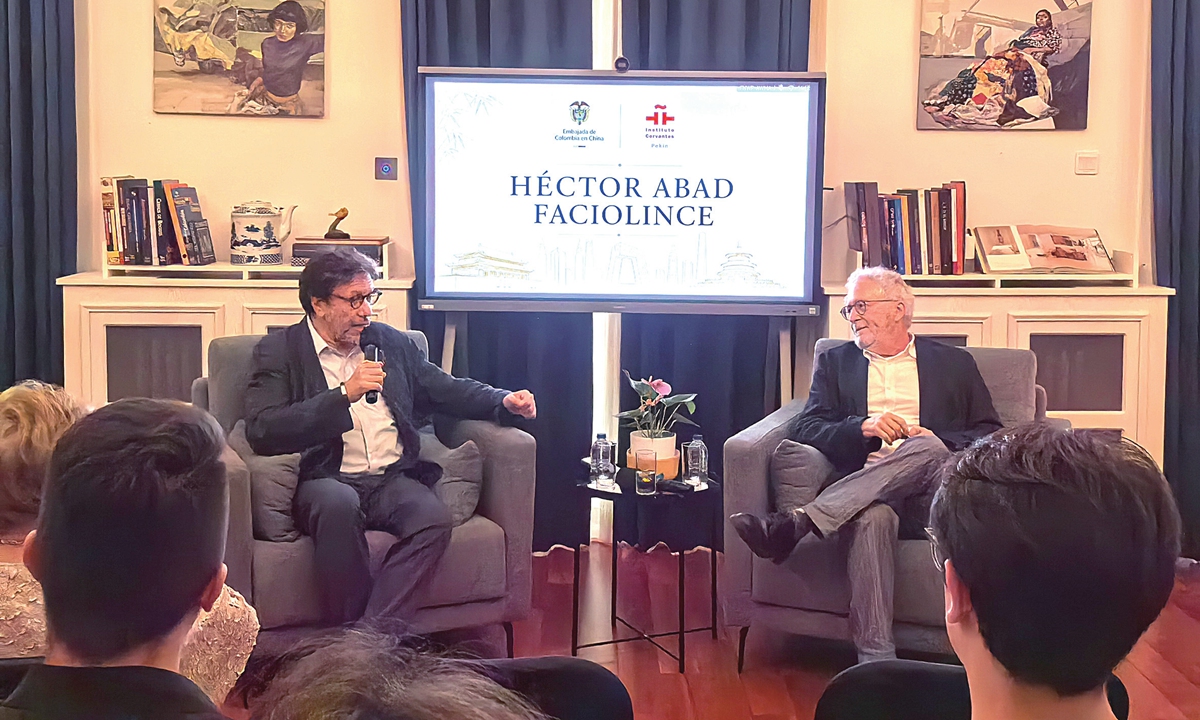
Santiago Gamboa, writer and minister counselor of the Embassy of Colombia in China, (left) and Héctor Abad Faciolince, a Colombian novelist, writer and journalist at a sharing session at the Embassy of the Republic of Colombia in China on August 18, 2026. Photo: Dong Feng/GT
The Embassy of the Republic of Colombia in China hosted a colloquium with Héctor Abad Faciolince, a Colombian novelist, writer and journalist. The writer shared on Tuesday his growth journey from a journalist to achieve his dream as a writer, his observation of the Colombian society and his impression about the changes in China.
In a fully packed hall, Minister Plenipotentiary Jose Fernando Bermúdez Cendales said in his opening remarks that the event is part of an initiative to bring Colombian culture closer to the Chinese public while simultaneously creating new spaces for dialogue and exchange between the two countries.
Bermúdez said that Abad's visit to China offers a particularly valuable opportunity to showcase the richness of our literature and to strengthen the cultural and human bridges connecting Colombia and China.
The session, chaired by Santiago Gamboa, writer and minister counselor of the Colombian Embassy, focused on the career and body of work of Abad and in particular,
El olvido que seremos (Oblivion: A Memoir).
Abad's book is a seminal work of contemporary Colombian literature in which personal and family memory engage deeply with Colombia's recent history. Its translation into Chinese allows this story to reach new readers and represents an extraordinary opportunity to bring both societies closer together through literature, per some commentators.
"We hope this gathering will be an open conversation among cultures, readers, and experiences, and a new expression of the friendship that Colombia and China continue to build," said Bermúdez.
Abad, one of the most important voices in contemporary Latin American literature, shared with the Global Times that this is his second trip in China. The last time he visited the country was two decades ago.
This time, in his eyes, China has changed a lot. In many ways, the country stands for the future of the world.
Abad said he is surprised to see how much Chinese people are depending on the electric devices and network to communicate in a virtual world, and said that he felt "like an alien."
Talking about his interaction with readers in Shanghai, Abad smiled, saying that the readers selected some phrases from his book and asked him to write down as part of the autography and signature for them.
In his book,
El Olvido Que Seremos (The Oblivion We Will Be), which is acclaimed as a "love letter from a son to his father," is not only a deeply affectionate look back at familial bonds but also a courageous attempt to defy oblivion.
Rooted in true events,
The Oblivion We Will Be chronicles the life of his own father. Abad noted that his father was killed in August 1987 - nearly forty years ago.
In the Western literary tradition, a father is often portrayed as a distant or even negative figure. His father, however, was "totally different - a man of love and deep sense of responsibility in both the public sphere and his family life."
Such image of a benevolent, non-authoritarian father has impressed his Chinese readers as well, he said.
As a physician, Abad's father dedicated his life to addressing fundamental issues affecting people's well-being, such as drinking water quality and public health, steadfast in the belief that the world could be made better through action.
Abad's work addresses themes such as memory, violence, inequality, and the human condition, deeply marked by the murder of his father, an event that inspired his most iconic book, The Oblivion We Will Be was published in Chinese by Writer's Publishing House in Beijing in July.
。
Current article:http://5gr4.nenyaogecebenliexi.shop/news/20260826_49591.html
Published on:00:00:00